

Recombinant SARS-CoV-2 Nucleocapsid Protein
Recombinant SARS-CoV-2 Nucleocapsid Protein with C-terminal His-tag, derived from the transfected human HEK293 cells.
 Datasheet
Product Description
Specifications
| Size | 100 ug, 500 ug, 1000 ug |
|---|---|
| Species | SARS-CoV-2 |
| Accession Number | QHD43423 |
| Protein Name / Synonyms | Nucleocapsid Protein, N Protein |
| Expressed Region | Met1-Ala419 |
| Expression System | HEK293 cells |
| Tag | C-terminal his-tag |
| Purification | His-tag affinity purification by immobilized metal ion affinity chromatography (IMAC) |
| Purity | >90 % |
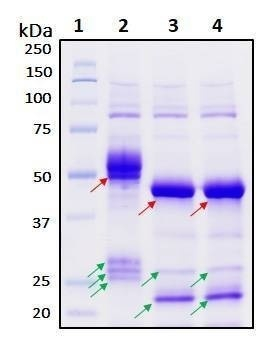
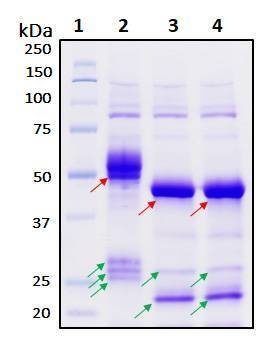
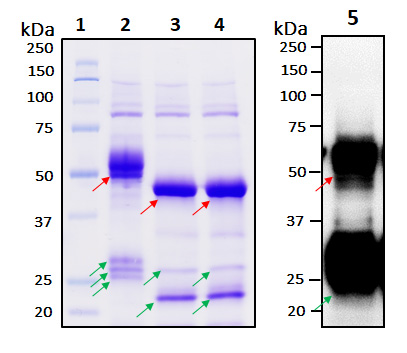
| Purity Determined By | SDS-PAGE under reducing conditions and visualized by Coomassie blue staining |
| Molecular Weight (kDa) | Recombinant protein product has a calculated molecular mass of 47 kDa. Due to the abundant glycosylation, it migrates as approximately 55 kDa major protein band in SDS-PAGE under DTT, beta-mercaptoethanol reducing conditions. The minor small protein bands (25-30 kDa) likely the cleaved products. See deglycosylation analysis image below. |
| Format | Liquid |
| Formulation | Supplied as a 0.2 µm filtered solution in PBS (pH 7.4) |
| Concentration (lot specific) | Lot specific (see the label on the vial), determined by BCA protein assay |
| Estimated Lead Time | 1-2 business days |
| Shipping Type | Blue ice |
| Storage | -20°C |
Related Products
Check items to add to the cart or
M Norman, et al. Ultrasensitive high-resolution profiling of early seroconversion in patients with COVID-19. Nat Biomed Eng (2020).
P Nguyen-Contant, et al. S Protein-Reactive IgG and Memory B Cell Production after Human SARS-CoV-2 Infection Includes Broad Reactivity to the S2 Subunit. mBio. 11 (5) e01991-20 (2020).
Keshavarz B, et al. Quantitative measurement of IgG to severe acute respiratory syndrome coronavirus-2 proteins using immunoCAP. Int Arch Allergy Immunol. 182(5):417-424 (2021).
Year:
2021
Journal Name:
Int Arch Allergy Immunol
PubMed ID:
123456
-
Great productIt works well for fluorescent labelling and confocal microscopy.
from University of California, Davis,
on
Write Your Own Review