
Bioinformatics Services
Array data must be analyzed with care to best identify differences between samples, but not everyone has the expertise or resources to properly process array data. Let our in-house biostatistics and bioinformatics experts analyze your data for you.
We can perform custom analyses for both genomics and proteomics data. For RayBiotech multiplex arrays, we offer á la carte options. We can also assist in experimental design. Click on a service below to learn more:
Tell us about your project and the type of analysis you need at techsupport@raybiotech.com. You can also call us at 770-720-2992 to quickly speak with a representative to help guide you.
Data Clean-Up
We recommend the data clean-up service for all array data as it forms the foundation for all subsequent biostatistics and bioinformatics analysis. Your final report will contain the protein expression data after data filtration, normalization, transformation, and outlier extraction (Microsoft Excel format) in addition to a detailed description of analysis steps performed (PDF format).

Outlier identification using Principal Component Analysis (PCA)
Differential Expression Analysis
This analysis identifies the proteins that are statistically significant between different groups of samples. This service is especially helpful for biomarker discovery / validation and profiling. The types of statistical analyses include:
Your final report will contain the following information:
- Description of analysis steps performed
- Comparison of statistical tests
- Result summary depicting p-values
- Volcano Map
- Jitter or swarm plot
Use to determine:
- Potential side effect discovery
- Exploration of drug molecular mechanisms
- Bioprocessing residue identification
- Biosimilar evaluation
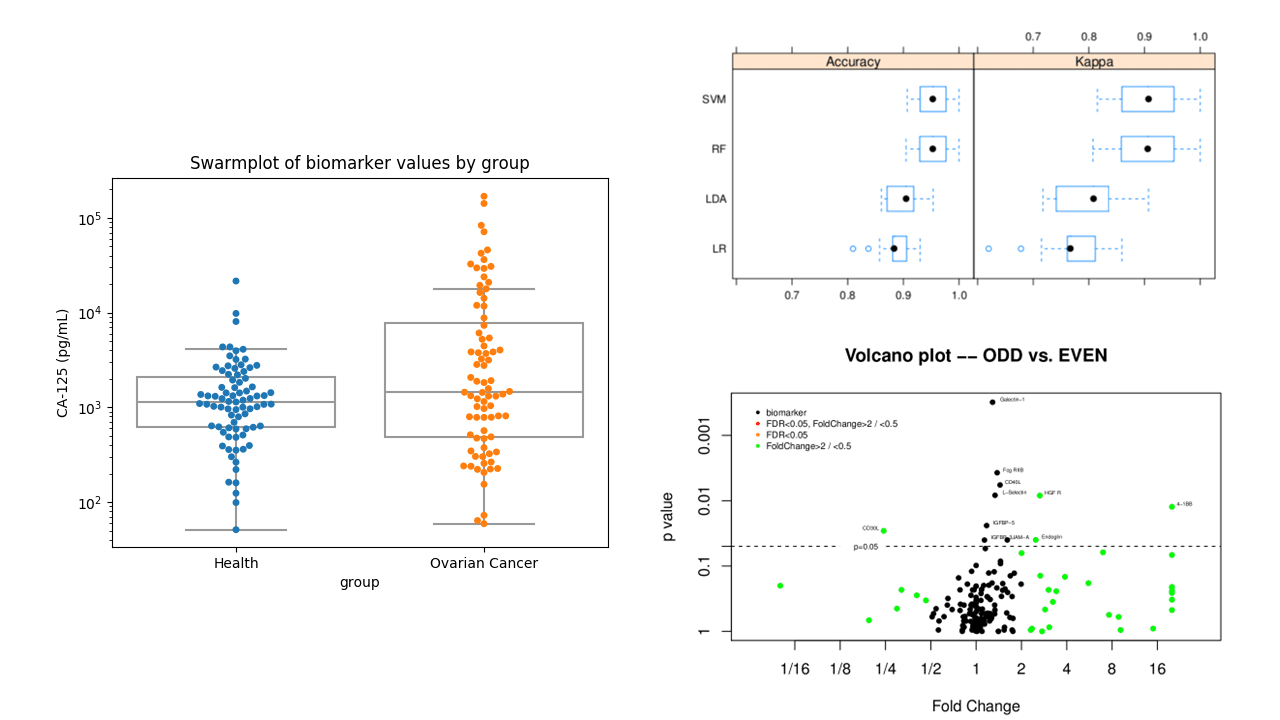
Jitter plot comparing sample groups for one biomarker candidate. Cross-validation and accuracy and kappa of biomarkers using different statistical tests. Volcano plot comparing sample groups.
Cluster Analysis
Cluster analysis identifies groups of markers with similar and different expression profiles across groups. This service is especially helpful for profiling and sample stratification. The final report includes:
- Description of analysis steps performed
- Hierarchical cluster
- PCA plot
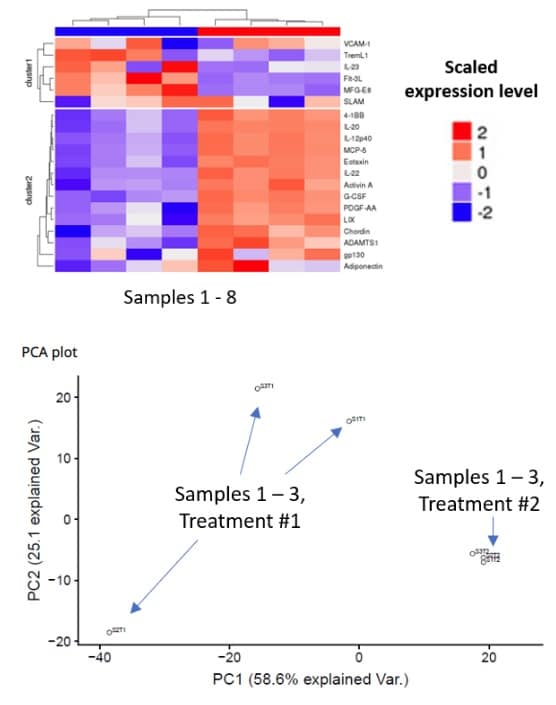
Hierarchical cluster and heatmap of 8 samples where red represents increased expression level and blue represents decreased expression level. Plot of PC1 and PC2 values of 6 samples. Samples subjected to Treatment #2 ("T2") cluster with each other but not with samples subjected to Treatment #1 ("T1"). Samples subjected to T1 do not cluster with each other.
Pathway Analysis
Pathway analysis identifies the specific protein functions, biological pathways, and physical interactions that are enriched in a particular group. The data are obtained from:
- GO (Gene Ontology)
- KEGG (Kyoto Encyclopedia of Genes and Genomes)
- STRING
This service is used for profiling, sample stratification, and biomarker discovery. Your final report will contain the following information:
- Description of analysis steps performed
- Pathway enrichment
- List of enriched pathways and FDR values
- List of the proteins, their known functions and processes, and p-values related to their enrichment
- Enriched biological pathways (see figure)
- Enriched molecular functions
- Enriched biological processes
- Protein interaction mapping
- List of proteins identified in your study that have known interactions with each other
- Protein interaction map (see figure)
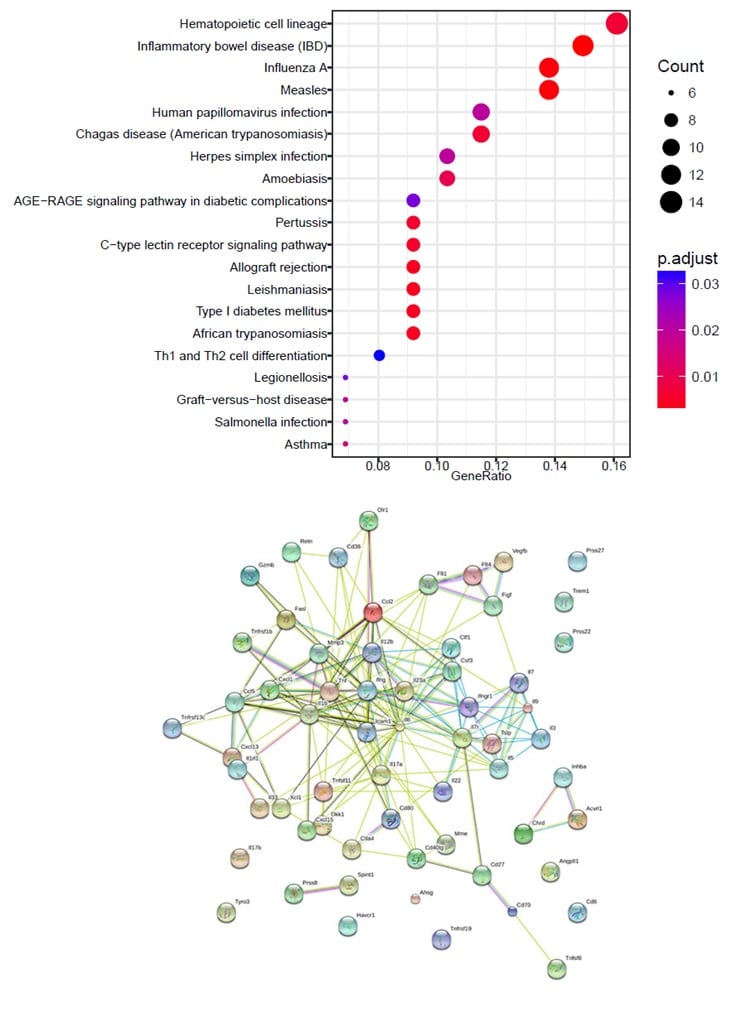
KEGG pathway over-representation analysis on differentially-expressed biomarkers (FDR < 0.05). Protein interaction map where proteins are represented as nodes and interactions as edges.
Biomarker Selection
Biomarker selection uses a variety of models to identify a subset of biomarkers that best differentiate the control from test samples. The models that are used in this service include:
- Logistic regression
- Linear discriminant analysis (LDA)
- Support vector machine (SVM)
- Random forest
- Other models may be used
Your final report will contain the following information:
- Description of analysis steps performed
- Predictive modeling using a subset of data
- ROC analysis
Discuss your project requirements

Frequently Asked Questions
Still have questions?
Still have questions?