Recombinant Mpox Virus IMV Surface Membrane 14-kDa Fusion Protein, A29L
Recombinant Mpox (formerly known as monkeypox) virus IMV surface membrane 14-kDa fusion protein (A29L) with a C-terminal His-tag, derived from the transfected HEK293 cells.
Product Description
Specifications
| Size | 100 ug |
|---|---|
| Species | Mpox Virus (MPXV) |
| Accession Number | Q90188 |
| Gene Symbols | A29L |
| Expressed Region | Met1-Glu110 |
| Expression System | HEK293 cells |
| Tag | C-terminal His-tag |
| Purification | His-tag affinity purification by immobilized metal ion affinity chromatography (IMAC) |
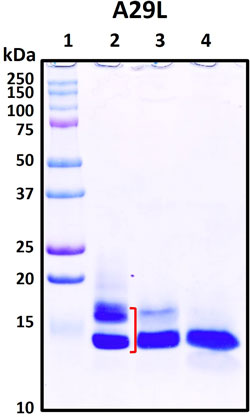
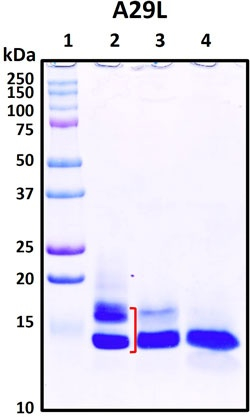
| Purity | >95% |
| Purity Determined By | SDS-PAGE under reducing conditions and visualized by Coomassie blue staining |
| Molecular Weight (kDa) | Recombinant protein product has a calculated molecular mass of ∼13 kDa. Due to the abundant glycosylation, it migrates as two major bands: approximately ∼13 kDa non-glycosylated form and ∼16 kDa glycosylated form in SDS-PAGE under DTT and beta-mercaptoethanol reducing conditions. |
| Format | Liquid |
| Formulation | Filtered solution in PBS with 1% mannitol and 5% trehalose |
| Concentration (lot specific) | Bio-Rad protein assay reagent |
| Endotoxin Level | <0.5 EU per µg of the protein as determined by the LAL method |
| Research Area | Mpox |
| Estimated Lead Time | 1-2 business days |
| Shipping Type | Blue ice |
| Storage | -20°C |