

Polyclonal Rabbit antibody against SARS-CoV-2 (COVID-19) Spike Protein S1 Receptor Binding Domain
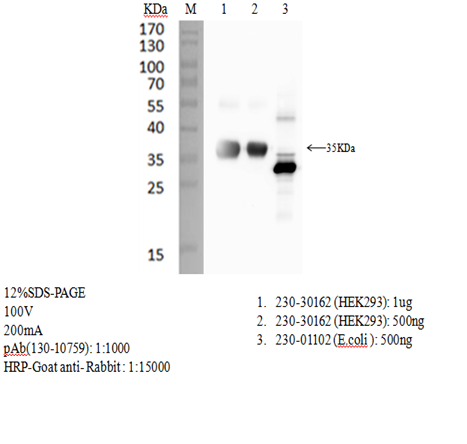
Product Description
Specifications
| Size | 20 µg, 100 µg, 200 µg, 500 µg, 1000 µg |
|---|---|
| Host Species | Rabbit |
| Accession Number | QHD43416 |
| Protein Name / Synonyms | SARS-CoV-2 S1RBD |
| Clonality | Polyclonal |
| Preparation | This antibody was produced from antiserum of rabbits immunized with a recombinant SARS-CoV-2 S1 RBD protein. The IgG fraction was purified by Protein A affinity chromatography. |
| Recommended Applications | ELISA (recommended work dilution = 1:160,000) |
| Reconstitution | Product is supplied as a powder obtained from lyophilization of purified antibody in 1X PBS, aliquot using ddH2O. Reconstitute the antibody with sterile water to a final concentration of 1 mg/ml. |
| Estimated Lead Time | 1-2 business days |
| Shipping Type | Ambient temperature |
| Storage | -20°C |
Related Products
Check items to add to the cart or
McCafferty S, Haque AA, Vandierendonck A, Weidensee B, Plovyt M, Stuchlíková M, François N, Valembois S, Heyndrickx L, Michiels J, Ariën KK. A dual-antigen self-amplifying RNA SARS-CoV-2 vaccine induces potent humoral and cellular immune responses and protects against SARS-CoV-2 variants through T cell-mediated immunity. Molecular Therapy. 2022 Sep 7;30(9):2968-83.
Azad T, Singaravelu R, Taha Z, Jamieson TR, Boulton S, Crupi MJ, Martin NT, Fekete EE, Poutou J, Ghahremani M, Pelin A. Nanoluciferase complementation-based bioreporter reveals the importance of N-linked glycosylation of SARS-CoV-2 S for viral entry. Molecular Therapy. 2021 Jun 2;29(6):1984-2000.
Write Your Own Review