Copeptin is a 39-amino acid peptide, mainly produced in the paraventricular neurons of the hypothalamus and in the supraoptical nucleus. It is cleaved from a protein also consisting of vasopressin and neurophysin II. Copeptin may help vasopressin folding during transportation. Vasopressin has a direct antidiuretic action on the kidney, and it also causes vasoconstriction of the peripheral vessels. Copeptin can be used as a vasopressin surrogate in clinical test. The clinical interest in copeptin testing is closely linked to the pathophysiological pathways in which vasopressin is involved, such as polydipsia-polyuria syndrome, hyponatremia, syndrome of inappropriate antidiuretic hormone secretion (SIADH) as well as heart failure and acute coronary syndrome.
Product Features
Strip plates and additional reagents allow for use in multiple experiments
Quantitative protein detection
Establishes normal range
The best products for confirmation of antibody array data
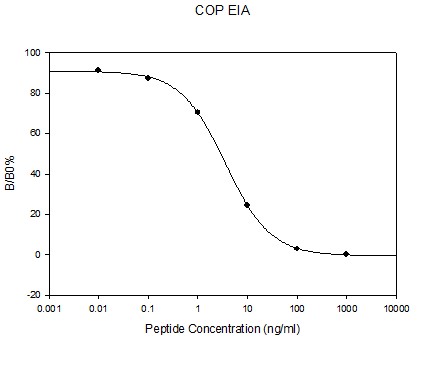
Typical Data
Standard Curve
Application Notes
Kit Components
Pre-Coated 96-well Strip Microplate
Wash Buffer
Standard Peptide
Assay Diluent(s)
Biotinylated Peptide
HRP-Streptavidin
TMB One-Step Substrate
Stop Solution
Assay Diagram
Positive Control Sample
Capture Antibody
User Manual
Other Materials Required
Distilled or deionized water
Precision pipettes to deliver 2 µl to 1 ml volumes
Adjustable 1-25 ml pipettes for reagent preparation
100 ml and 1 liter graduated cylinders
Tubes to prepare standard and sample dilutions
Orbital shaker
Aluminum foil
Saran Wrap
Absorbent paper
Microplate reader capable of measuring absorbance at 450nm
SigmaPlot software (or other software that can perform four-parameter logistic regression models)
Protocol Outline
Prepare all reagents, samples and standards as instructed.
Add 100 µl detection antibody to each well.
Incubate 1.5 h at RT or O/N at 4°C.
Add 100 µl standard or sample to each well.
Incubate 2.5 h at RT.
Add 100 µl prepared streptavidin solution.
Incubate 45 min at RT.
Add 100 µl TMB One-Step Substrate Reagent to each well.
Incubate 30 min at RT.
Add 50 µl Stop Solution to each well.
Read plate at 450 nm immediately.
Storage/Stability
Standard, biotinylated peptide, and positive control should be stored at -20°C after arrival. Avoid multiple freeze-thaws. The remaining kit components may be stored at 4°C. Opened microplate wells and antibody (Item N) may be stored for up to 1 month at 2° to 8°C. Return unused wells to the pouch containing desiccant pack and reseal along entire edge.
Product seemed to work as described using human serum samples with low CVs, but all samples appeared within standard curve using recommended dilution. Instructions worked well, though personally I prefer having the paper manual to follow.
Review byAnonymous,
fromUniversity of North Carolina at Greensboro,
on
Great product
Rating
80%
We use this kit for testing human copeptin concentration in patient's cerebrospinal fluids.